Five operational problems. One signage platform.
Wayfinding, queue management, patient education, emergency communication, and Medicare/billing workflow — Australian hospitals, GP clinics, and aged care are quietly replacing whiteboards with networked screens. This is what a real deployment looks like.
Australian hospitals, GP clinics, dental practices, allied health centres, aged care facilities, and day surgeries are quietly replacing whiteboards and laminated A4 with networked displays. The reason isn’t aesthetic — it’s that medical digital signage resolves five operational headaches in one platform.

Three Things That Make Healthcare Signage Different
Reducing perceived wait time, improving wayfinding, providing education — these measurably reduce stress and improve outcomes.
Anything with a camera, microphone, or personal identifier must clear APP and state health privacy reviews before deployment.
Code blue, lockdown, evacuation, fire — must take over every screen in seconds, no admin intervention required.
By Care Setting: Where the Screens Go
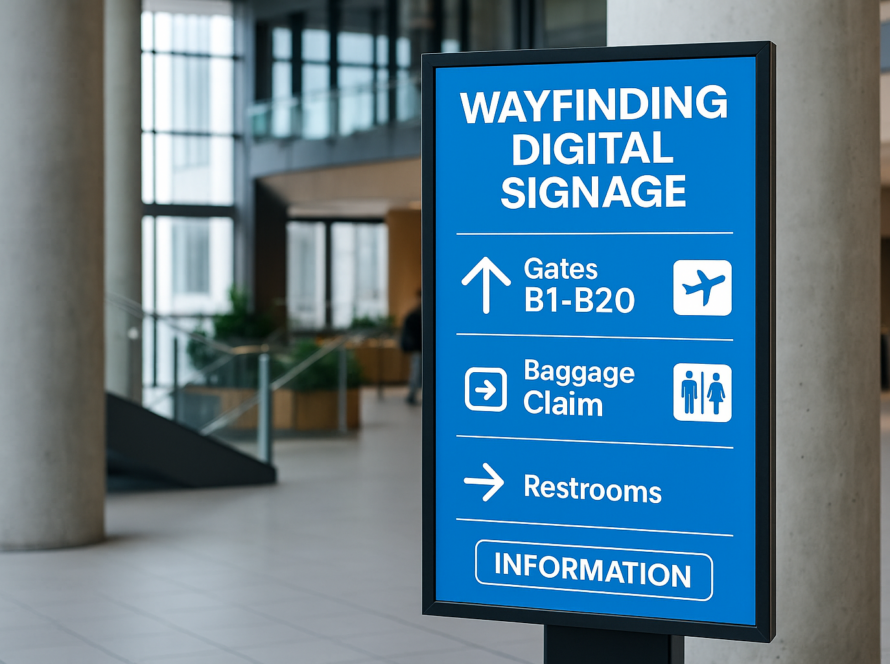
Wayfinding + visitor information.
Directories, today’s clinics and theatre lists (de-identified), parking, news, infection-control reminders. Touch kiosks free reception staff for triage.
Public-area screens shouldn’t show patient identifiers, even on theatre lists. De-identify by token or first-initial format.
Education + queue + perceived-wait reduction.
Patient education videos, health campaigns, wait-time estimates, now-serving displays. Reduces front-desk interruptions and turns dead time into wellness content.
Patient names. Conditions. Specialist clinic names (“Diabetic Foot Clinic — Mr Smith”). Use tokens or appointment numbers.

Triage explainers + category waits + public-health alerts.
Triage category explainers, expected-wait categories (not individual times), public-health alerts, family communication boards for patients in care.
One-click switch: code blue, lockdown, fire. Every screen full-screen in seconds. Local trigger mode if cloud connectivity drops.
Setting-specific content profiles.
Visiting hours, ward information, family education. Paediatric wards run distraction content. Aged care uses oversized text, high contrast, predictable visual rhythm.
Healthcare audiences are anxious. Calm pacing, large text, generous white space. Loud, fast, busy content fails here.
Staff-side scheduling and equipment status.
Today’s list (de-identified), surgeon schedules, recovery bay availability, infection-control reminders, equipment status. Staff-side displays only — never patient-facing.
Theatre and ICU screens must be on UPS or generator-backed circuit. Brownouts are common in older AU hospital builds.
Education + chair-side treatment walkthrough.
Treatment education in waiting rooms, before/after galleries (with consent), chair-side treatment plan walkthrough, post-treatment care reminders.
No testimonials on clinical outcomes. No misleading before/afters. No inducements. Brand storytelling is fine; clinical claims are not.
Self-service + queue + pre/post-test instructions.
Self-service check-in kiosks, queue management, fasting reminders, post-test instructions. Significant reduction in front-desk load.
Anti-microbial bezels and touchscreens in patient-contact areas. Silver-ion or copper-impregnated. Sealed front surfaces — no fan vents.

Daily activities, family connection, mealtimes.
Day calendar, resident birthdays, weather, family video messages, news. Large-format high-contrast displays optimised for reduced vision.
Min 18 pt body text on aged-care screens. High contrast (WCAG AA min). Predictable rhythm — no fast transitions or strobing.

Privacy: APP and State Health Law
Australian healthcare signage is governed by the Privacy Act 1988 (APPs), state-based health records laws (e.g., NSW HRIP Act, Victoria HRA), and AHPRA professional standards. The non-negotiables:
Use tokens, first-name-and-last-initial, or appointment numbers. Never “Mr John Smith — Diabetic Foot Clinic.”
On-device only, no frame storage. Privacy impact assessment before deployment.
Explicit signage-use consent. Print-only consent does not transfer.
AU regions where possible. Some state health depts mandate AU-only residency.
Reception screens visible from the waiting room shouldn’t show patient identifiers.
Track who changed what content. Compliance audits will ask.
Integrating With Patient Management Systems
Standalone signage works. Signage integrated with PMS is where operational lift happens.
Medical Director
Genie
ZedMed
Pracsoft
AutoMed
Custom via FHIR / HL7
- Now-serving queue. Patient checks in → token issued → screen calls when clinician calls them. Fully automated after setup.
- Wait-time estimation. PMS knows average consult durations × current queue → “currently running about 20 min late.”
- Clinician availability. Doctor leaves the room → reception screen updates.
- Multi-site dashboard. Practice manager monitors queues across multiple clinics from one console.
What It Costs in Australia (2026)
Add-ons: anti-microbial display premium A$300–800, PMS integration setup A$2,000–8,000, emergency override module A$1,500–4,500 setup + A$50–150/screen/month, healthcare CMS A$25–60/screen/month, PIA (if camera analytics) A$3,500–8,000.
200-bed hospital ward block: A$80,000–160,000 depending on integration complexity. See packages.
Seven Common Mistakes in Healthcare Signage
The #1 APP breach. Use tokens.
A complaint closes the program faster than any other issue.
Operations first, marketing second. Lead with wayfinding, queue, education.
Die within 12–18 months. No commercial integration.
Waiting-room wellness content during code blue is a regulatory liability.
Vision-impaired patients, wheelchair users, non-English families all need to use it.
Healthcare audiences are anxious. Calm pacing, large text.
21-Day Healthcare Pilot
Stakeholders + metric
Map practice manager, IT, clinical lead, privacy officer. Define one outcome — reduced front-desk interruptions, improved patient experience score, or reduced perceived wait.
Privacy + procurement
PIA if camera-enabled. Approve content categories with clinical lead. Procure hardware. Schedule electrician.
Install + integrate
One waiting-room, one reception, one queue display. PMS integration in test environment. Train staff.
Go live + measure
Operational use cases first (queue, wayfinding). Layer education content. Compare against baseline.
Frequently Asked Questions
Is digital signage allowed in Australian healthcare?
Yes — used widely across hospitals, GP clinics, specialist, allied health. Constraints are around privacy (no identifying patient info on screens) and AHPRA advertising for promotional content.
Can I display patient names on the now-serving screen?
No — privacy breach under APP. Use tokens or appointment numbers. Patients can opt in with explicit consent but it shouldn’t be the default.
Do I need a privacy impact assessment?
If signage includes cameras for audience analytics — yes, most state health departments require a PIA. Content-only signage doesn’t need a PIA but should have a documented privacy posture.
Can it integrate with Best Practice, Medical Director, or Genie?
Yes — most modern signage platforms support integration via API, HL7, or FHIR. Common cases: now-serving queue, wait-time estimation, clinician availability.
What about infection control?
Anti-microbial bezels and touchscreens in patient-contact zones. Smooth sealed surfaces (no fan vents on front). Cleaning protocols should include the displays.
Can patients leave testimonials on signage?
AHPRA prohibits testimonials about clinical care. General experience testimonials may be acceptable but should be reviewed against current AHPRA guidance.
What does a typical GP clinic rollout cost?
3-room clinic with reception display, 2 waiting-room screens, queue display, PMS integration: A$14,000–22,000 first year, A$150–300/month ongoing.
Scope your healthcare signage.
Trial the platform on existing hardware, talk to us about PMS integration and privacy review.
Related reading: AI digital signage · Installation guide · Schools