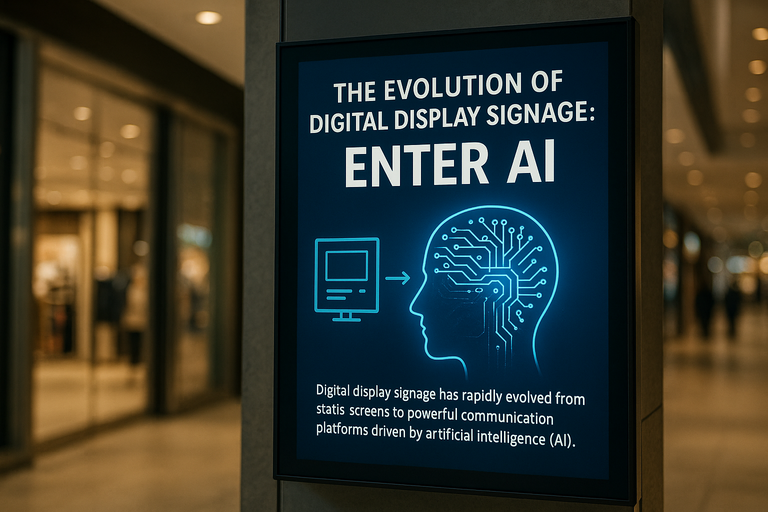
From kindergartens in Brisbane to universities in Sydney, digital signage for schools has shifted from a nice-to-have to a core part of campus communication. Industry research consistently shows that nearly all students notice and recall content shown on digital displays within seconds of walking past — something the laminated A4 notice on a corkboard simply can’t match.
Static notice boards miss most of the people they’re meant to inform. Kids walk past them. Parents don’t see them. Updating them is a manual chore. Digital screens flip that equation: one CMS, every campus, content that updates in seconds.
This guide covers what Australian education leaders need to know about digital signage education deployments in 2026 — use cases, hardware, AI-powered features, cloud CMS, installation, cost, and how to get started.

Why Australian Schools Are Adopting Digital Signage
Three forces are driving adoption across K-12 and tertiary education in Australia right now:
- Communication overload. Schools push announcements through emails, app notifications, paper notes, and assemblies. Most fall through the cracks. Screens in high-traffic zones — entrances, canteens, libraries — put the message where students and parents actually are.
- Safety and emergency response. Lockdowns, evacuations, severe-weather alerts. These demand instant, campus-wide messaging that a paper bulletin board simply can’t deliver.
- Engagement and culture. Celebrating student achievement, broadcasting live sports scores, welcoming visitors on arrival — this builds a sense of community that static signage doesn’t.
What Counts as Digital Signage in Education?
The term covers any internet-connected display showing dynamic content. In practice, signage for education in Australian schools usually means one of four formats:
- Indoor LCD/LED screens mounted in foyers, corridors, and staff rooms (32″–75″)
- Interactive touch displays in libraries and reception areas for wayfinding and student self-service
- Outdoor LED screens at the school gate for community announcements and event promotion
- Video walls in auditoriums or sports halls for assemblies, awards, and broadcasts
All four connect back to a single cloud-based content management system (CMS), so a teacher in the office can update a screen at the other end of campus — or another campus entirely — without leaving their desk.
Types of Content You Can Display on School Digital Signage
Once the hardware is up, the question becomes: what do we put on the screens? A well-run deployment cycles through a mix:
- Daily timetables, bell schedules, and room-change notices
- Weather alerts, sun-smart reminders, and UV index
- Sports results and academic achievement spotlights
- Canteen menus with allergen tags and pricing
- Library new arrivals and reading recommendations
- Live news feeds and student-produced content
- Birthday shoutouts and “student of the week”
- Emergency alerts and lockdown instructions (full-screen override)
- Open day countdowns and enrolment promotions
- Welcome messages for visiting parents and incursions
- Career nights, sports carnivals, and musical promos
- QR codes linking to forms, payment portals, or school apps
10 Ways Schools Use Digital Signage
1. Wayfinding for Parents and Visitors
Open days, parent-teacher interviews, and incursions bring strangers onto campus. Interactive directories at reception turn a frustrating walk into a 30-second self-serve experience — and free up admin staff who’d otherwise be giving the same directions ten times an hour.

2. Daily Announcements and Bell Schedules
Today’s timetable, room changes, assembly reminders, weather warnings — pushed to every screen in seconds. No more rewriting the whiteboard at 7:45 a.m.
3. Celebrating Student Achievement
Sports results, academic awards, art showcases, birthday shoutouts. Cycling these on hallway screens turns recognition into something the whole school sees, not just the families on the email list.
4. Emergency and Lockdown Alerts
With one click, every screen on campus switches to an evacuation map, lockdown notice, or assembly point. Modern digital signage in education systems integrate with PA, SMS, and email so all channels trigger together.
5. Canteen Menus and Pricing
Live menu boards with allergen tags, daily specials, and queue-busting QR codes. Update once, reflect everywhere — and meet Australian nutritional labelling expectations without reprinting.

6. Library and Resource Promotion
New arrivals, recommended reads, opening hours, silent-zone reminders. Touchscreen catalogues let students search without queuing for help.
7. Classroom and Lecture Theatre Displays
Corridor screens outside classrooms double as period schedules — especially useful in secondary schools and universities where students move between rooms every period.
8. Room Booking and Resource Scheduling
Small displays mounted outside meeting rooms, music practice rooms, or science labs show real-time availability and a one-tap booking option. Cuts double-booking and wasted lesson time.
9. Event Promotion and Community Building
Sports carnivals, musicals, fundraisers, alumni events — promote internally on campus screens and externally on outdoor LED at the school gate. Track engagement by which posters get the most QR scans.
10. Student-Created Content
Give media, design, and journalism classes a real audience. Student work on hallway screens drives more pride and ownership than a printout on the noticeboard ever did.
Cloud-Based CMS: Why Central Management Matters
The single biggest reason modern digital signage for schools works at scale is the move to cloud-based CMS platforms. A good CMS gives you:
- Multi-campus control — Manage every screen across every campus from one browser tab. No more remoting into individual machines.
- Role-based access — The principal, IT coordinator, head of year, and canteen manager each see only the screens and content they’re allowed to touch.
- Advance scheduling — Build the whole term’s promotional calendar in one sitting; the system publishes content at the right time, on the right screens.
- Live monitoring — Get an alert when a screen goes offline so you fix it before someone else notices.
- Offline resilience — Quality players cache content locally and keep playing if the school Wi-Fi drops.
- Security — End-to-end encryption, SSO with school identity providers, audit logs of who changed what.
How AI Is Changing Digital Signage for Schools
AI-powered features are starting to land in digital signage education deployments and shift signage from broadcast to context-aware:
- Audience-aware content. A privacy-respecting on-device camera detects whether the audience is mostly Year 7s or visiting parents, and adjusts content accordingly. No faces, names, or images leave the player.
- Automated content generation. AI drafts announcement copy, weekly newsletters, and event posters from a simple prompt — slashing the admin time it takes to keep screens fresh.
- Smart scheduling. The CMS learns peak foot-traffic windows in the canteen, library, or gym and surfaces the right message at the right time.
- Multi-language translation. For schools with high LBOTE (language background other than English) populations, AI pushes the same announcement in English, Mandarin, Arabic, or Vietnamese automatically.
- Smart moderation. AI checks user-generated content before it goes live — important when students contribute to the playlist.
If you’re new to AI in this context, our AI-Powered Digital Signage Guide covers the architecture in more depth.
Hardware and Software: What Schools Actually Need
A typical Australian school deployment includes:
- Displays: Commercial-grade screens rated for 16-hour daily operation. Avoid consumer TVs — they burn out under continuous use and void warranties.
- Media player: A small AI-powered device (or built-in SoC) that runs the signage app and streams content from the cloud.
- CMS: Cloud-based content management with role-based access, so the principal, IT coordinator, and head of year can all schedule content without stepping on each other.
- Network: Standard school Wi-Fi works for most indoor screens; outdoor LED installs typically need wired Ethernet for reliability.
- Mounts and enclosures: Vandal-resistant for hallways and outdoor units; tilt mounts for height-adjusted readability.
Sign Inspire’s player runs on Android, keeps playing if the network drops, and supports remote firmware updates — important when one IT team supports multiple campuses across a system. You can download the player and trial the platform before committing.

Installation: What to Plan For in Australian Schools
Installation in school environments has a few quirks worth scoping early:
- Term timing. Schedule the install during school holidays. Cabling and drilling in active corridors disrupts learning and triggers safety concerns.
- Power and data points. Older buildings rarely have power where you want screens. Factor in electrician time for new GPOs and Ethernet runs.
- Compliance. Working-with-children checks for installers, asbestos clearance for pre-1990 buildings, and WHS sign-off for ceiling-mounted units.
- Network access. Many education networks block outbound ports by default. Coordinate with the IT coordinator on whitelisting before install day.
- Mounting height. Aim for the midpoint of the screen at 1.5–1.6 m above the floor. Higher than that and primary students can’t read it; lower and corridor traffic blocks it.
Our digital signage installation service covers all of the above as a turn-key engagement across NSW, VIC, QLD, and SA.
How Much Does Digital Signage for Schools Cost in Australia?
Indicative ranges for an Australian deployment in 2026:
- Per-screen hardware (43″ indoor): A$1,200 – A$2,200 depending on brightness and brand
- Per-screen hardware (55″ indoor): A$1,800 – A$3,500
- Outdoor LED (P3–P5, ~3 m²): A$15,000 – A$35,000 installed
- Media player (per screen): A$250 – A$600
- CMS subscription: A$15 – A$50 per screen per month
- Installation: A$300 – A$800 per indoor screen, A$2,500+ for outdoor LED
A primary school deploying 6 indoor screens typically lands between A$12,000 and A$22,000 all-in, with ongoing CMS costs of A$100–A$300 per month. See our pricing page for current packages.
Procurement and Funding for Australian Schools
Schools rarely fund signage from a single line item. Common funding paths include:
- P&C fundraising for community-facing outdoor screens
- Capital works budgets when integrated into new build or refurbishment
- ICT refresh cycles, replacing aging projectors with combined signage/display units
- State grants — for example, NSW Resources for Learning funding
- NSW Buy and other state procurement panels for compliant supplier engagement
Operationally, most schools treat CMS subscriptions as an OPEX line under ICT or marketing.
Getting Started: A 30-Day Plan
- Week 1. Walk the campus and map the top 5 locations by foot traffic. Take photos, note power and data access.
- Week 2. Workshop content ownership with the leadership team — who’s allowed to publish what, and who approves.
- Week 3. Pilot with one screen in the main reception. Test announcement workflows for a fortnight.
- Week 4. Review engagement, refine the playlist structure, and scope the wider rollout for next term break.
FAQ
Is digital signage worth it for a small primary school?
Yes — even a single reception screen replacing the noticeboard pays back in admin time saved within a year. Start small and grow.
Can teachers update content themselves?
With a modern CMS, yes. Role-based access means a Year 6 teacher can publish to the Year 6 corridor screen only, while admin staff control campus-wide announcements.
What happens if the internet drops?
Quality players cache content locally and keep playing the scheduled loop. Sign Inspire’s player runs offline indefinitely and syncs when the network returns.
Do screens need to be on 24/7?
No. CMS scheduling powers screens down outside school hours, which extends panel life and cuts electricity cost.
What about student privacy with AI-powered features?
Audience analytics in education-grade signage are anonymised and on-device — no faces, names, or images leave the player. Confirm any vendor’s privacy posture before deploying in K-12 environments.
How long does a typical school deployment take?
For a 6-screen pilot, expect 2–3 weeks from order to live — most of that is scheduling around term holidays and the electrician.
Can digital signage integrate with our school management system?
Modern signage platforms ingest data via API from SIS, timetabling, and weather feeds. Bell schedules and live timetables can update automatically from your existing system.
Next Step
If you’re scoping digital signage for schools in Australia and want a no-obligation walkthrough of options for your campus, download the Sign Inspire player to trial the platform, or check current pricing for a budget reference. For ongoing case studies and configuration guides, see our AI digital signage hub.
Looking for adjacent guides? See our deep dives on retail digital signage and AI-powered signage players.