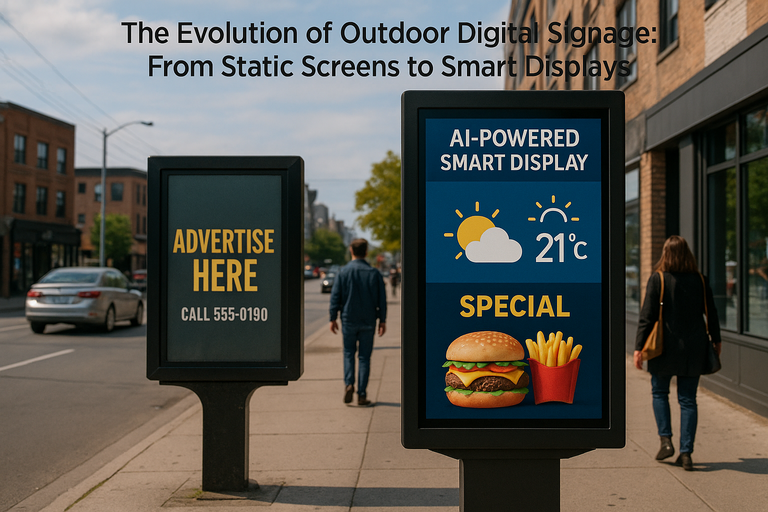
If you run a café in Fitzroy, a boutique on Chapel Street, or a clinic in East Melbourne — you’ve probably noticed the term AI digital signage popping up in 2026. Until last year, “digital signage” mostly meant a CMS that scheduled images and videos on screens. Now, AI platforms are doing the planning, designing, scheduling and publishing for you.
So is the AI version actually different, or just a marketing repaint? Here’s an honest comparison from someone who builds one of these platforms in Australia.
What is traditional digital signage?
Traditional digital signage is a content management system (CMS) plus a media player. You upload your own images, videos and slide decks; you schedule when they play; you push them to screens. Most Australian providers — Fusion Signage, ScreenCloud, NoviSign — work this way. They give you the plumbing; you provide the content and the strategy.
If you have a marketing team and a graphic designer on staff, this works fine. If you’re a café owner who also makes the coffee — it doesn’t. You end up updating the menu board twice a year because nobody has time to design new content every week.
What is AI digital signage?
AI digital signage replaces the human content team with a software team. The AI looks at your sales, the weather, the calendar, your stock levels and local events — then builds a weekly campaign calendar, designs the artwork, drafts the copy, schedules it to the right screens at the right times, and learns from what actually sold.
The platform we build, Sign Inspire, is built as a team of nine specialised AI agents — one for promotion planning, one for campaign design, one for menu boards, one for publishing, and so on. Each does one job well and hands off to the next, like a real marketing agency. Except this team works weekends, never forgets a public holiday, and costs a fraction of one designer.
Quick test: if your screens are showing last month’s special right now, you’ve probably outgrown traditional signage. AI signage exists because most businesses don’t have time to be content creators.
Side-by-side comparison
| Traditional digital signage | AI digital signage | |
|---|---|---|
| Content creation | You design every poster, image or video — or pay a designer | AI generates on-brand artwork in minutes from a brief |
| Scheduling | You build the calendar each week manually | AI builds the weekly calendar from sales, weather, events |
| Updates | Someone has to remember to swap the artwork | Auto-updates from POS, calendar and weather feeds |
| Measuring impact | Hard — needs a separate analytics tool | Connected to POS; reports what each campaign sold |
| Multi-location management | Each store updated individually | One dashboard, every store, per-location rules |
| Approval flow | Whoever has admin can publish | Built-in queue with brand guardrails |
| Time per week (multi-location) | 3–6 hours | 15 minutes to approve |
| Cost (per screen / month, AU) | A$25–A$60 + designer fees | ~A$10/screen — all-in |
When traditional signage still wins
To be fair — traditional CMS still wins for a few specific cases:
- You already have a content team. If you have an in-house designer and marketing manager, a traditional CMS is a cheaper “rendering layer”.
- Your content is fixed. A museum playing a curated 10-minute loop year-round doesn’t need AI — it needs reliable playback.
- You don’t trust AI to make creative decisions. Fair. Most AI signage tools (ours included) let you turn Autopilot off and just use the AI as a “first draft” engine.
When AI digital signage is the clear choice
If any of these match your business, AI is probably worth it:
- You change menus, promos or window displays at least monthly
- You run more than one location and want them all on-brand without a head office content team
- Your screens are currently a chore — they get updated by whoever has time, not on a real schedule
- You want to actually measure what screens drove sales (instead of guessing)
- You’re a single owner-operator with no marketing staff
What this looks like in Australian business
Different industries get different value out of AI signage. Here’s what we see across our Australian customer base:
- Cafés & restaurants: Biggest immediate win is the digital menu board — change one coffee price on your phone and every store updates in seconds. Day-parted menus (breakfast → lunch → dinner) run themselves.
- Retail: Window displays that react to weather and AFL game days. New-arrival campaigns generated in a minute instead of a week.
- Gyms & studios: Class timetables synced to your booking software; member promos and trainer spotlights on autopilot.
- Clinics & healthcare: Calm waiting-room content with seasonal health messaging, scheduled around clinic hours and public holidays.
- Multi-location chains: Roll out a campaign across 50 sites with one approval — including per-suburb variations (different weather, different events, different stock).
If you’re in Melbourne specifically, we’ve written a dedicated guide to AI digital signage for Melbourne business with examples from Fitzroy laneway cafés to Chapel Street boutiques and Brunswick fitness studios.
The real cost question
Most Australian businesses we talk to assume AI digital signage costs more. It usually doesn’t — because the ~A$10 / month / screen (plans are A$29–A$99) is inclusive of content creation. With traditional signage, you’re paying ~A$25–60/screen plus the time of whoever creates the content (a designer at A$400 per poster, or your own 3–6 hours per week).
Do the maths for a 5-screen, multi-location café:
- Traditional: A$30/screen × 5 = A$150/month + ~4 hrs of owner time × A$80/hr = A$320 hidden labour. Real total: ~A$470/month.
- AI (Sign Inspire Creator plan): A$49/month covers all 5 screens, full AI team included, 15 min of owner approval (~A$20). Real total: ~A$69/month.
See our full digital signage pricing page for the breakdown.
The honest verdict
For most Australian businesses in 2026, AI digital signage isn’t about hype — it’s about removing the single biggest reason digital signs go stale, which is nobody has time to update them. If your screens are currently a chore, that’s the symptom AI fixes.
Our recommendation: don’t migrate just because the AI is shiny. But if you’re spending more than 2 hours a week wrangling content for screens, or your screens are quietly showing yesterday’s specials right now — try a free pilot. One screen, one month, no commitment. You’ll know within two weeks whether the time saved is real.
Want to see AI digital signage run on your business? Sign Inspire offers a free pilot — one Australian screen, full AI team included, cancel any time.