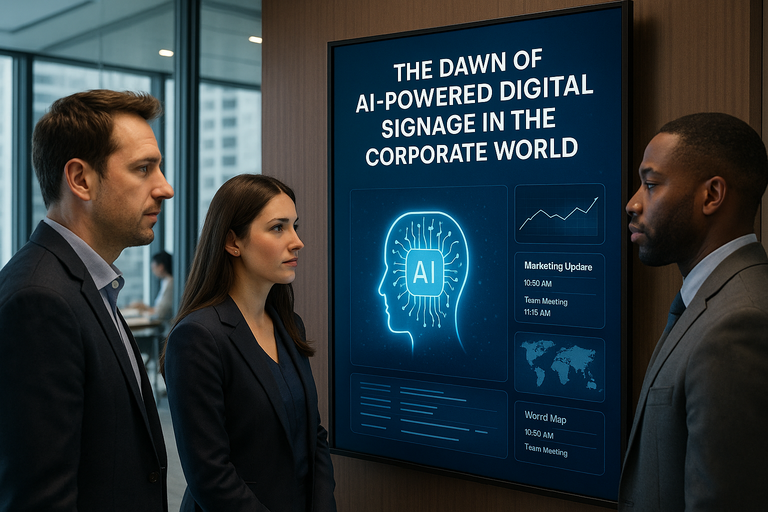
AI Digital Signage isn’t a feature. It’s an operating system for every screen on your premises.
Displays that read the room, generate content on demand, predict their own failures, translate live, and report ROI. Here’s what’s real, what’s hype, and what to deploy first.

What AI Digital Signage Actually Means in 2026
Traditional digital signage broadcasts a fixed playlist on a schedule. AI-powered signage layers three new capabilities on top: perception (it knows who or what is in front of the screen), decision (content selected from a pool by context, not by timer), and generation (copy and visuals produced on demand). The screen looks the same. The brain behind it doesn’t.
Fixed playlist, fixed timer.
- Same content for every audience
- Manual updates per location
- Reactive maintenance only
- One-language assumption
- No attribution
Adapts in real time.
- Audience-aware content selection
- Centralised + auto-generated content
- Predictive maintenance alerts
- Multi-language on tap
- Closed-loop attribution data
The 7 Core Capabilities Worth Knowing
Computer Vision Analytics
Anonymised demographics, dwell time, attention duration — on-device, no PII leaves the player.
NL Generation
LLMs draft headlines, body copy, and event descriptions from a brief. Half a week of marketing time, back.
Image & Video Generation
Imagen, Flux, Veo generate brand-consistent visuals on demand. Two-week agency briefs become five minutes of prompting.
Predictive Maintenance
Watches panel temp, brightness drift, pixel performance. Alerts before failure — saves truck rolls at scale.
Smart Scheduling
Learns peak dwell windows per screen, schedules priority content into them.
Live Translation
English / Mandarin / Arabic / Vietnamese on tap. Essential for high-LBOTE catchments.
Engagement Scoring
Sentiment + dwell + sales data → closed-loop attribution. Did the screen actually move units?

How It Works Under the Hood
A typical 2026 AI signage deployment stacks five layers:
By Industry: Where AI Signage Pays Back First
What’s New vs Marketing Spin
- Multimodal LLMs generating copy + image + layout in one pass
- On-device analytics with APP/GDPR posture
- Predictive maintenance that actually saves truck rolls
- “Smart scheduling” is mostly rule-based with light ML
- “Dynamic content” has existed since early 2010s
- What’s new is generated content quality, not dynamism
- Reading customer emotions to high accuracy in public spaces
- Most benchmarks show 60–75% on coarse categories
- Useful for trends, dangerous for individual decisions
Australian Privacy Principles: What You Have to Get Right
Anything with a camera on Australian commercial property triggers APP review. The non-negotiables:
Visible signage at entry telling customers analytics are in use — even when anonymised.
No frames stored. Only aggregated metrics leave the device.
Schools, hospitals, government need a PIA before deployment.
Privacy posture in writing. Server-side image storage = red flag.

ROI: When AI Signage Pays Back (and When It Doesn’t)
- High-traffic retail and QSR (4–12% basket lift)
- Multi-site networks 10+ screens (ops cost savings dominate)
- Healthcare and education (qualitative, but reliable funding)
- Single screen in low-traffic corridor
- Internal-only office signage for sub-50-person teams
- Anywhere static signage is already doing the job
What It Costs in Australia (2026)
Add-ons: audience analytics camera A$300–800 per screen, content-generation subscription A$30–120/mo per org, predictive maintenance A$10–25/screen/mo. See current packages.
The 30-Day AI Signage Pilot
One screen. One metric. One AI feature at a time. Projects fail when seven features deploy simultaneously and no one can tell which moved the number.
Pick location + metric
One location with measurable foot traffic. One outcome (engagement, basket lift, queue time, NPS).
Baseline
Install AI-ready screen + camera + CMS. Run measurement with AI features off.
Enable feature 1
Usually audience-aware content first. Compare against baseline.
Layer feature 2
Add AI content generation or predictive maintenance. Decide rollout.

Six Pitfalls When Adopting AI Signage
If existing screens have stale content and no remote management, AI won’t fix that.
Directional only. Useful for trends, dangerous for individual decisions.
One angry customer post shuts the program. Notice + minimisation up front.
Screens that read too much make customers feel surveilled.
AI-generated content still needs human approval, especially in regulated industries.
Avoid players that only run one CMS. Open hardware + open CMS = flexibility.
Frequently Asked Questions
What is AI digital signage in one sentence?
Digital displays that adjust content automatically based on audience, context, and data — using ML, computer vision, and generative AI — instead of running a fixed playlist on a timer.
Does AI signage record customer faces?
A privacy-respecting deployment doesn’t. On-device analytics extract anonymised attributes and discard underlying frames immediately. Confirm vendor posture in writing.
Do I need new hardware to use AI features?
For most features (content generation, smart scheduling, predictive maintenance) — no, the CMS handles them. Audience analytics specifically needs a player with a camera or external camera module.
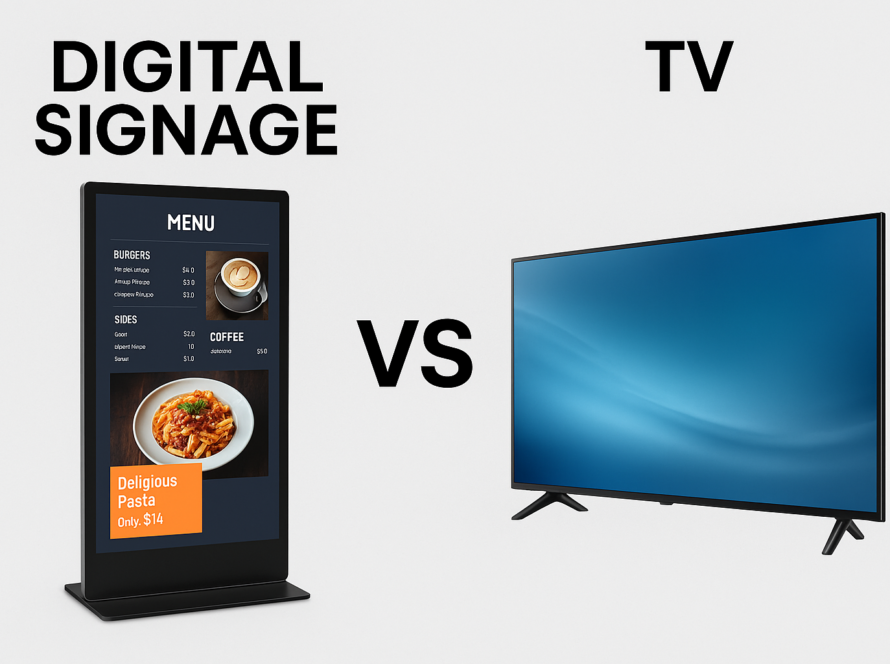
What’s the difference between AI and dynamic signage?
Dynamic changes by rules (“show this 9–11 a.m.”). AI changes by learned models (“show this when traffic exceeds X and demographic skews Y”). Same screen; smarter brain.
Is AI signage worth it for a small business?
Usually not for a single screen. Economics work from about 5 screens, or where one screen drives meaningful revenue (drive-thru menus, busy retail entries, healthcare lobbies).
How long does an AI signage rollout take?
Pilot in 30 days. Multi-site rollout in 8–12 weeks. AI features enable quickly; slow parts are install, network, and content governance.
Can it integrate with my existing systems?
Most modern CMS platforms expose APIs for inventory, POS, weather, traffic, calendar. Plan integration architecture during pilot, not after rollout.
Ready to start the AI pilot?
One screen. One metric. Thirty days. We help you scope it.
Download the player View pricingCompanion reading: AI architecture guide · Schools · Installation · Retail · Players
📖 Selling property? See how AI signage moves listings off the wall and into walk-ins. Read: Digital Signage for Real Estate Australia — AI Window Displays
📖 Running a corporate workspace? See how AI signage handles wayfinding, room booking and internal comms. Read: Corporate Digital Signage — AI-Powered Workplace Displays (2026)